Howse wants to reclaim the church

Brannon Hose Last week, Brannon Howse wrote an article explaining why a biblical worldview is so critical in light of trends showing more and more people leaving the church. It seems to be mostly a marketing ploy for his program materials, but he rants on for quite a bit. He cites a book by Ken Ham titled Already Gone: Why your kids will quit church and what you can do to stop it. In the book, Ham had surveys taken from conservative congregations and found that today’s kids are leaving the church at a record rate… and not just in college.

In addition, he concludes that Sunday school doesn’t help kids develop a Christian worldview and that they are “statistical failures.” Sunday school, it seems, is allowing parents to “shrug off their responsibility as the primary teachers, mentors, and pastors to their family.”

I’ll agree that there seems to be (at least anecdotally) an increasing number of parents who do “shrug off” their responsibilities in raising their children, but if Sunday school keeps them from indoctrinating their kids with a religious worldview, then I can’t help but think Sunday school can be a good thing.

From the article…

Only 11 percent of those who have left the Church did so during the college years. Almost 90 percent of them were lost in middle school and high school. By the time they got to college they were already gone! About 40 percent are leaving the Church during elementary and middle school years!

Of course, Howse’s answer to this “crisis” of mass church exodus is “Biblical worldview and apologetics training” (conveniently available for purchase from his website). Howse laments that, even though the church has had billions of dollars, only 1% of adults have what he defines as a “Biblical worldview” and teens are leaving the church in ever-increasing numbers because they don’t have that worldview. In this article, he doesn’t spell out exactly what that worldview entails (though I’m sure he does elsewhere on his site), but he does mention that churches that used to be evangelical now “reject the exclusivity of Jesus Christ, the inerrancy of Scripture and most of the essential Christian doctrines.”

He expounds a bit on what should be happening in the churches.

Even among our truly evangelical, Bible-believing churches, how many churches teach the Biblical worldview for law, science, economics, history, family, social issues, and education? At church do adults or students learn about the lie of global warming, radical environmentalism, socialism, evolution, postmodernism, situational ethics, political correctness, population control, the myth of the separation of church and state, the Biblical worldview for marriage, the Biblical role of men and women and the lie of feminism?

There’s just so much wrong in that one paragraph that it threatens to make my head hurt. When people talk about injecting religion (especially fundamentalist, evangelical religion) into every aspect of our lives, my skin starts to crawl at the thought. It’s not because, as some theists claim, that I want to live my life however I want and be able to do whatever I want without eternal consequences. I’ve addressed that before. It’s because the implication is that dogmatic, inflexible, 2,000-year-old mythology, when vehemently applied to modern life, will improve our standard of living. It’s a horribly Orwellian idea, but folks like Howse would love to have it applied world-wide.

He continues by criticizing the church’s actions.

Because the church is not answering the real-world questions of our students and the public school system is, Christian youth increasingly believe that at church we deal with “spiritual” issue but at school we talk about “real life” issues. The truth is, all issues are spiritual; every issue can be examined in light of Biblical principles but not if the church is only teaching Bible stories instead of Biblical principles contained in those Bible stories.

Schools are supposed to teach answers to “real life” issues… especially our public schools. Howse’s brand of woo (or any brand, for that matter) has no place in our public school system, for at least three reasons. First, it’s unconstitutional to promote a religious view in our schools. Second, Howse’s version of Christianity is intellectually dishonest. Third, Christianity (and other theistic religions) is morally ambiguous at best and frequently morally reprehensible.

The window of freedom is closing on America and soon I, and our other speakers, could be prosecuted for the Biblical truth we are teaching. Hate-crime laws would do just this.

That’s Howse at his alarmist, fear-mongering best. Hate-crime laws would never prevent anyone from speaking about their religion, regardless of how absurd or spiteful their religious views are. His alarmism continues with vague statements about what I assume to be the “Fairness Doctrine” and a prayer at a booster club luncheon, implying that jail time is inevitable for people who speak from a “Biblical worldview.”

Then comes another sales pitch that hinges on the OMG!!! from the previous paragraph.

Worldview Weekend is training, equipping, and encouraging individuals of all ages that will be just like these men. Our nation needs Christians that will stand up and speak out with the truth of a Biblical worldview even in the face of persecution and prosecution.

Of course, it wouldn’t be Brannon Howse if there wasn’t some conspiracy theory hullaballoo thrown in for good measure (emphasis mine).

[…] the worldview war in America is connected to four major forces; occultism/pagan spirituality, the apostate church, corrupt government/corporate officials and the educational establishment. All four of these groups are aggressively working at the national and international level to accomplish their ultimate goal of global governance as predicted by many New Age writers like Alice Bailey. The Bible predicts this will occur and at this year’s rallies we will look at how God would have us to respond to what is happening at break-neck speed.

If I didn’t think he was serious, I’d find his writing hysterically funny. As it is, it’s both disturbing and sad. People like Howse, who seem to be barely hanging onto the fringe of the fundamentalist, right-wing precipice, want to teach their views as truth to our nation’s children. It’s bad enough that otherwise seemingly rational adults subscribe to this intellectually harmful nonsense, but to promote the foisting of this drivel onto our children is reprehensible.

Fortunately, as the beginning of his article notes, kids are leaving the church in droves. No doubt some of that is from apathy, but it’s nice to imagine that some of them are just coming to the realization that religion is simply an unnecessary obstruction to a healthy, happy life. It’s also hard to buy into the “young earth creationist” idea that The Flintstones is an accurate portrayal of history.

Howse ends his article with a plea for help in getting those wayward kids back in church. He wants help distributing magazines to advertise his seminars, he wants prayers, and of course, he wants money.

Because, you know, woo is expensive.

Fireproof Could Have Been Good – Review Part 2

Fireproof... Never leave your partner behind In part one of this review of the movie Fireproof, I gave my overall view that the movie wasn’t as bad as I’d expected, but still squandered the potential it had to be a decent love story. In part two, I’ll focus on some specifics as well as address some of the religious issues of the movie.

Despite the potential for a nice romance movie, there was so much wrong with the entire script (even setting aside the religious aspect) that any chance for a decent level of watchability was destroyed. Irrelevant scenes, undeveloped characters who suddenly seem important, stilted and contrived dialogue, female stereotyping, and a myriad of other problems all effectively screen the underlying story from being the focus.

Much of the acting was bad, but none worse than the young doctor who attempts to woo Catherine, despite her being married. In his case, the bad writing was not the sole cause of his lackluster performance. He came across as decidedly creepy, with pickup lines that deposited a virtual oily slime on the camera. In the end, there’s an implication that he is married as well, so he becomes a double scumbag… but his complete lack of appeal and disturbing stalker-like creepiness were the worst parts.

There were many useless scenes in the movie that added nothing to the story and were simply time-killing distractions. The gag with the hot sauce and the egotistical fireman, Wayne, seemed to have no point. The minor interaction with the one firehouse atheist was pointless. The entire religious “message” seemed secondary. It would have worked if it had been more of a focus (or at least shown to be the reason for the marriage being saved), or had been addressed in a less heavy-handed, clumsy way.

The religious dialogue that was scattered throughout the movie didn’t seem to contribute to the story. The dad, John, made some comments here and there. When Caleb commented on his long drive, he said, “It gave me time to think and pray.” …hopefully not with his eyes closed. Caleb’s “don’t tell me about Jesus” protestations seemed weak. The father’s dialogue was generally badly written and poorly acted, but other than the main conversion scene, didn’t really offer much of a message of Christian goodness.

What about that message? There was really very little, if any, explanation of why Christianity had anything at all to do with the saving of Caleb and Catherine’s marriage. That’s what made the message so weak. All the actions shown from the “love dare” book were secular in nature, except the day where Caleb was supposed to pray for Catherine, which he admitted he didn’t do… which seems to be showing that, even without the religious parts, the marriage was saved. Caleb has his conversion, but it’s ignored for the better part of the second half of the movie, so there was no connection there, either unless the implication is, because he’s accepted Jesus, he’s willing to clean the house, wash the dishes, and buy his wife flowers.

Addressing the religious points from an atheist perspective, I’d have to say there was a lot of silliness.

  • Caleb’s father says, “[Jesus has] become the most significant part of our lives. When I realized who I was and who he was, I realized my need for him. I needed his forgiveness and salvation.” To me, that’s sad. If a dead guy is more significant than your wife and children, not to mention a myriad of other joyous things in life, then your priorities are so far out of whack that a serious reality check is in order. Need his forgiveness? Need his salvation? What?
  • The conversion speech John gives to Caleb is right out of Cameron’s Way of the Master evangelizing program. “God judges by his standards.” … “His standards are so high he considers hatred to be murder and lust to be adultery.” … When Caleb asks about all the good he’s done, his father replies that it doesn’t matter because “You’ve broken his commandments and one day you’ll answer to him for that.” … “Jesus loves you even though you rejected him.” It’s creepy and the message that you can’t know what love is without Jesus is just offensive.
  • When the oncoming train almost hits the lieutenant while he’s helping move a car off the tracks, he sits down and says, “Thank you, God. Thank you, Lord.” I think it would be more appropriate for him to be thanking the other folks who helped get the car off the tracks before the train came by. If God had wanted to help, he could have just stopped the train… or moved the car… or perhaps kept the car accident from happening in the first place. To give thanks to a god who almost kills you is just absurd.
  • When Caleb is rescuing the young girl from the burning house and gets trapped in a room, he says (uncharacteristically, I might add), “God, get us outta here!” He then proceeds to use his axe to hack through the wooden floor and escape safely from under the house. This almost made sense, because, even though he asked God for help, he got out by himself. Quick thinking and taking action saved his life, not a benevolent god. Again, if God had wanted to help, he could have kept the building from catching fire in the first place, or at least gotten the girl to go outside before burning her home to the ground.
  • There was an implication that, unless you give your life to the Lord, it’s all about “my rights and needs.” I don’t think the “Lord” has anything to do with that. Just the opposite, in fact. If someone is “accepting Jesus” because they want eternal salvation or to avoid eternal damnation, that seems pretty self-centered to me.
  • Caleb tells Catherine, “God has given me a love for you that I had never had before.” What he’s telling her is that he can’t possibly love her without divine intervention. That’s insulting on a grand scale.
  • Caleb says, “The love dare changed my life.” and his father responds, “God changed your life. The love dare was just a tool he used.” That’s classic Christian thinking right there. Don’t give credit where the credit is due, but credit God for working in mysterious ways. It’s brilliant because it fits any situation and it’s irrefutable. You can’t prove that God didn’t use the love dare to save your marriage!
  • When Caleb finds out his mother did the love dare on his father (and not the other way around) and now knows that she’s all Jesus’y, he’s sorry for treating her badly and runs to tell her how much he loves her. “Dad, I have treated her so wrong!” Caleb cries. The implication is, of course, that only the godly folks are worthy of good treatment. His mother didn’t change in the past month, but when he suddenly finds out that she’s “all in,” his attitude toward her is completely changed. It’s hypocritical and repugnant.

There are more things like those, of course, but those are some of the highlights. None of those things added anything to the story, but their poor execution just hindered both the Christian message and the quality of the movie. The writer’s attempt to make the connection between Christian beliefs and the success of the marriage failed on a grand scale. However, it did (if you could wade through all the muck) make quite a good connection between kind, secular actions toward your spouse and the success of a marriage. Caleb started doing nice things for Catherine and it made him a better person… and she noticed.

That was the real message.

Fireproof Could Have Been Good – Review Part 1

fireproof02 I finally got around to watching the movie Fireproof, the Christian-themed movie with Kirk Cameron as a fire chief who is having marital problems that get solved by accepting Jesus. I’ll admit I was biased going in, not just because I knew it was a Christian-themed movie, but because I’d heard, from both atheists and Christians, that it was horrible. The most common criticism I’ve heard is that Kirk Cameron is just a terrible actor.

As it turns out, I didn’t dislike it nearly as much as I’d expected, and there were some parts that I actually enjoyed, so it wasn’t a total loss. Yes, Cameron’s acting was bad at times, but not in comparison to some of the other actors’ performances, and there were some funny moments and some touching moments that were handled nicely.

Here’s the quick summary of the plot. Caleb (Kirk Cameron) and his wife Erin (Catherine Holt) are having serious marital problems and a divorce is imminent. Caleb complains about Erin to his father, John (Harris Malcom), who had gone through similar problems that were solved by a 40-day “love dare.” He suggests that Caleb try it. Caleb gives his word to go through the entire 40 days, so his father gives him the “love dare” book which gives a new behavior to do each day… refrain from saying anything negative, do something nice, buy her something nice, etc. Each day builds upon the last. Around day 20, Caleb is ready to give up because it’s not working, but his father visits and inspires a religious conversion. The rest of the days play out with Caleb willingly working the 40-day plan. It ends happily and they renew their wedding vows.

Why does the movie fall short of what it could have been? My opinion is that it had the makings of a good Lifetime Channel type of movie, but fell apart because of the writing, the acting, and the incongruent messages.

The acting was admittedly sub-par, but throughout the movie, it was hard to tell whether it was the fault of the actors or of the writers. Some of the dialogue was painfully stilted and I kept thinking to myself that nobody talks like that. There are some scenes, however, that are perfectly believable… even touching… so I have to think that the actors had some talent, but were handicapped by the poor writing.

There are very few movies that I specifically notice the directing, and when I do, it’s invariably a bad thing. The first The Incredible Hulk (with Eric Bana) is a good example because the comic-book style scenes were jarring (and I disliked them immensely). I noticed the directing in Fireproof, too. At times, it seemed clumsy (“Why are they focusing on that?”) and at times, there were scenes included that added nothing to the movie (the brief interchange with the atheist). It wasn’t consistent throughout the movie, but, like The Incredible Hulk, it was jarring when it happened… and it happened enough to be annoying.

Some scenes, however, were fairly well done. There was a rescue scene where two girls were trapped in a car on a train track and a train was coming. The firemen were trying to move the car off the tracks and all the spectators joined in, getting it moved just in time… so “just in time” that one of the firefighters was close enough to the train to have his fire hat knocked off. That’s close… and the entire scene was both tense and touching. Cameron was believable barking orders and the camera work was well done.

Another rescue scene came later when Caleb was trying to get a little girl out of a burning house and hacked through the wooden floor with an ax, escaping just before the roof collapsed and something exploded. The tension was well handled and it was all believable during Cameron’s scenes. Outside the burning house, the seemingly random, Keystone-Cops-like chaos was another matter, but it wasn’t the focus of the scene, so it wasn’t a big distraction, though I did find myself briefly wondering why they weren’t more effective at helping Caleb.

Other scenes were well-done, too, and weren’t ruined by bad direction, acting, or writing. They were refreshing.

The Christian message seemed muddled and secondary… and somewhat ham-handed. Caleb tells his father, John, that he doesn’t want to hear about Jesus and his father doesn’t push it at first. The 40-day “love dare” book John sends him seems quite secular until we find out there’s a bible verse at the end of each day. However, other than the “Pray for your wife” day (which Caleb admits he skipped), all the actions seemed secular (make dinner, do something nice, say something nice, etc). It was unclear why religion was a necessary part.

Then came the day-20 visit by John where Caleb’s upcoming conversion is overtly set up by his complaining about Erin and angrily asking how he could possibly love someone who rejects him again and again. As he’s talking, his father is slowly walking around a small campsite and ends leaning against a cross. Caleb sees his father standing by the cross, and after his father delivers a bit of poorly written, clumsy dialogue right out of Cameron’s Way of the Master evangelizing program, gets it. He accepts Jesus, admitting that he needs Jesus’ forgiveness and that he will trust Jesus with his life.

After his conversion, Caleb becomes willing and eager to do all the rest of the “love dare” program, regardless of how Erin reacts. I assumed that the implication is that his change of heart came from his acceptance of Jesus. However, aside from a few insignificant scenes where Caleb shares his newly found inspiration, the movie continues with actions that could just as well be secular in nature. It’s almost as if the writers took a good love story and jammed in some Christian evangelizing so it would be a “Christian” movie.

There’s so much more I could say about this movie. There were some really funny parts (when Caleb makes coffee for Erin, the hospital girls, the oh-so-lame flowers) and some parts that were really painful to watch (interactions between Caleb and his father, the goosebump-inducing creepiness of the young doctor, the insulting stereotyping of women), but overall, it seemed like it was a promising, inspirational love story that was irrevocably marred by poor writing and a clumsy insertion of an incongruent Christian message.

But the fire trucks were cool.

(more thoughts on the details in my next post)

Religion as a Weapon

The Holy Qur'an There have been a rash of deaths recently in Pakistan due to accusations that the victims desecrated the Qur’an. You can read about some of them here and here.

The population in general, and Christians in particular, is dealing with cases of intimidation because of Pakistan’s blasphemy laws. The laws, one of which carries the death penalty for "defiling the Koran and images of the Prophet Muhammad" are suspected of being used "to settle personal scores."

The second article (the BBC one) says that the blasphemy laws were introduced in the mid 1980’s and "hundreds of people have been lynched" because of them. Blasphemy laws are absurd to begin with (do you hear that, Ireland?) and in this case, seem to fuel the fire of religiously-inspired righteous indignation. They practically invite abuse.

The BBC’s M Ilyas Khan in Islamabad says there is recurring evidence that people have sought to settle personal scores with victims by inflaming religious feelings.

From the first article:

Hundreds of armed supporters of Lashkar-e-Jhangvi, an outlawed Islamic militant group, set alight dozens of Christian homes in Gojra town at the weekend after allegations that a copy of the Koran had been defiled.

[…]

Tension started mounting last week after Muslims accused three Christian youths of burning a copy of the Koran. They denied the allegations, but clerics called for their death. On Saturday hundreds of supporters of Lashkar-e-Jhangvi, an outlawed Sunni sectarian group, poured into the town from surrounding districts.

A mere accusation of destroying a book, made without proof, was sufficient to rouse a mob of hundreds of Muslim people angry enough to burn down houses and fire their weapons indiscriminately. In another case, a woman was almost attacked because a shopkeeper accused her of throwing the Qur’an. In yet another, a factory owner and a co-worker were killed because he removed an old calendar from the wall that had verses from the Qur’an (though was accused of desecrating the Qur’an).

Whatever the motives behind these actions (in the case of the factory owner, it’s suspected it was spurred on by wage disputes), the fact remains that unsupported accusations of Qur’an desecration are all that’s needed to whip people into a blind rage of pious, violent, fury. Because someone possibly "disrespected" a book… a mere copy of a book… Muslim religious fundamentalists will kill… and feel vindicated. That’s horrific, repugnant, and morally reprehensible.

Christians vary in degree only. Witness the recent outrage over the destruction of bibles in Afghanistan by the United States military this past May. There was no rioting in the streets… no throwing of molotov cocktails… no firing of guns… no violence. But the religious indignation was there. The sense of pious outrage, the outcry of revulsion at the act, the self-righteous bible thumping, the gathering of like-minded protestors, the wailing about persecution… it was all there. It simply didn’t progress to the same level of violent action as the Muslim outrage did.

And that feature of religion, that ability to easily create a wild frenzy of devout, sanctimonious outrage, is one of its more dangerous aspects. It’s a feature that is easily abused, as shown by the recent activities in Muslim Pakistan. In the United States, it’s abused for political and monetary gain, among other things. It’s used by religious leaders all around the world… that exploitation of blind faith.

It’s the foundation of religion.

Putting the “Good” Book in Context

god fire

I have had many theological discussions with Christians and inevitably at some point during our discussion the comment, “you’re taking the meaning out of context” is dropped. I think that a contextual understanding of the bible and Christianity is important also. Let me take this opportunity to try and put the bible and Christianity in it’s proper context.

There is plenty of terrible un-Godlike behavior in the new testament, but for sure it is easier to quote better examples of God’s loveless actions from the old testament. I have had people tell me, “…well yeah that’s the old testament but the new testament is much more peaceful”. I will be taking quotes for most of this article from the old testament.  I will be doing so because the old testament is particularly brutal. If you are a Christian and you believe the inspired word of God is infallible (and you have to), why does it matter that only the brutish old testament is mentioned? Having been written first, it has the distinction of being perhaps more timely and therefore more accurate (disbelief appropriately suspended) to the events that it describes.

Let’s start with the bronze age’s answer to Las Vegas, Sodom and Gomorrah. God was not happy with the evil taking place in the twin cities so he decided to rain down upon them “burning sulphur.” This is odd and cruel at the same time. Odd because if you were God, do you think burning sulphur would be the best way to completely wipe out two cities? Cruel because it involves burning men, women and children. Wouldn’t a 30 mile wide plasma beam be more efficient or at least more humane? It’s also a lot more cool than… burning sulphur.  Keep in mind bronze age construction had advanced from an earlier technique of packed clay walls to actual bricks made from mud.  Mud bricks don’t burn well, in fact heat is what is used to dry them. Weird God would choose such an incredibly inefficient way to smite people… unless the bible was written solely by men who didn’t know what a plasma beam or anything else more advanced was than… burning sulphur. Hard to keep this story any more in context than that.

Next, let’s talk about God’s quirky sense of humor. Just imagine if you had a neighbor whose name was, oh I don’t know, ahhhh… Abraham. Let’s say some “guy” showed up at Abraham’s house one day and put a gun to Abraham’s head and tried to force him to kill his son, ahhhhh… Isaac. Then right before Abraham did it the “guy” stopped him and said “Wait! I just wanted to see if you’d do it!”  Would we think this “guy” was funny, smart, all knowing, all powerful, peaceful, kind, or loving. No, we’d think this “guy” was vicious, cruel and twisted. I think you get the point. If God was omniscient, he would have already know what Abraham was going to do or he’s just a malevolent jerk who gets off on yanking mankind’s chain. Not very Godlike… unless God was a creation of mankind who from time to time does suffer from these character flaws. Hard to keep this story any more in context than that.

Now, Exodus 2:29-30 :

At midnight the LORD struck down all the firstborn in Egypt, from the firstborn of Pharaoh, who sat on the throne, to the firstborn of the prisoner, who was in the dungeon, and the firstborn of all the livestock as well. Pharaoh and all his officials and all the Egyptians got up during the night, and there was loud wailing in Egypt, for there was not a house without someone dead.

Does anything here strike you as odd? Yeah I know, “why should God kill the children for the wrongs of their parents?”. Sure that’s unforgivingly evil, but that’s not even the “odd” part. I’m talking about killing the firstborn of the livestock! The livestock? Here is context for you. Throughout the bible, God has penalized mankind by killing his children and/or his livestock. In an earlier article I quoted Leviticus 26:21-22.

If even then you remain hostile toward me and refuse to obey, I will inflict you with seven more disasters for your sins.  I will release wild animals that will kill your children and destroy your cattle, so your numbers will dwindle and your roads will be deserted.

God sure has a thing for killing livestock… or does he? Seems to me far more likely that mankind in the bronze age recognized how valuable livestock was to the other bronze agers of the time and decided to use livestock as leverage in the good book. Sounds again like mankind was truly doing the story telling here. Hard to keep this story any more in context than that.

I could go on…but I think it is clear that contextually these stories and most likely the entire bible, were man made from start to finish. How modern day rational people can’t see that the bible is riddled with un-Godlike, but very human, behavior is astounding to me.

…Sometimes a burning bush, is just a burning bush.

Secular Student Alliance at the Creation Museum Today

Many folks with the Secular Student Alliance group (283?) are visiting the Creation Museum today and are using Twitter to inform those of us who can’t make it today. If you’ve got a Twitter account, you can follow their tweets using the hashtag “#CreoZerg”. I’ll be following it today and am really looking forward to reading all the writeups tomorrow.

One person posted an Urban Dictionary link to the origin of the “Zerg” part of the hashtag.

Here’s the scoop [sic]:

Originates from Blizzard’s game Starcraft where zerg were one of 3 playable races, aliens like appearance, zerg were characterized by using large numbers of weak units to swarm the enemy, also another characteristic of zerg were that everything was organic, ie, zerg didn’t used machines or any artifacts, they would mutate their own buildings from special kind of larvae and advanced units were created by mutating basic ones. Units were cheap to make and it was possible to make extreme numbers in short period of time.

Nowadays term zerg is used in mmo games to describe force consisted of large group of lower level players (often with only basic equipment) who use numbers rather then strategy to defeat the enemy, therefore requiring no skill. This tactics is commonly known as “zerging.”

Too funny.

Richard Dawkins has nearly infinite patience

Richard Dawkins Richard Dawkins has a DVD titled The Genius of Charles Darwin which includes interviews with various people about evolution. Today, in a post on Pharyngula, PZ Myers told folks from the Secular Student Alliance that, if they’re engaged in conversation during their visit tomorrow at the Creation Museum in Kentucky, they can probably expect the type of exchange in the following interview from the DVD.

It’s in seven parts and the seventh video drops partway through the dialogue (which evidently it does on the DVD, too), but seven parts is more than enough. I watched all seven, but really, after the first video, there wasn’t much point in continuing. It was somewhat like the old “watching the train wreck” scenario, though, that kept me going. The interviewee, Wendy Wright from the Concerned Women for America, really didn’t listen to the questions… or answer them… or acknowledge what Dawkins was saying… or make much sense. It almost seemed (!!!) as if she were a talking head who mechanically distributed creationist talking points… and who could really do nothing else.

Dawkins tried his best and was incredibly tolerant and polite, though you could tell he was frustrated during many of the exchanges because Wright wouldn’t acknowledge what he was saying. She repeated, ad nauseum, the claim that there is no evidence for evolution, and refused to acknowledge his examples of evidence… even to disagree with them! It was as if Dawkins wasn’t even speaking. She even made claims that DNA evidence which supports evolution really supported special creation. Dawkins was tossing out pieces of evidence but it was like throwing ping pong balls at a brick wall. There were so many times that she implied that the evidence was irrelevant to what she believed.

Watching the full video was painful, but educational. Wright is actually the president of the CWA, who’s website bills her as a “Policy Expert and Activist” and a “United Nations Lobbyist.” This is not a “fringe” representative of a fringe organization, but someone who engages the media on a regular basis, evidently. It’s painful to hear someone like Wright, who is so willfully ignorant of facts (and reality), try to influence public policy.

Watch the video if you can stomach it. I’d love to hear comments.

httpv://www.youtube.com/watch?v=b4mLGmPMvls

I feel pretty! Oh, so pretty!

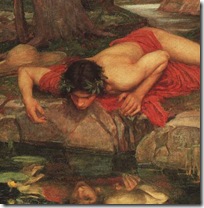
Narcissus I’ve read a number of accounts where atheists are accused of being narcissistic, because we supposedly set ourselves up higher than God… more important… smarter… too independent. We think we’re better than God, so the claim goes. I’ve always found that very odd since, by its very nature, atheism generally indicates the opposite view.

We’re not special. We’re animals, very much like all the other animals on this planet. We’re not the "pinnacle of creation" but are merely evolutionary products who continue to evolve as time slowly marches inexorably past. We are born. We live. We die. There’s no grand plan. There’s no heavenly purpose. In the grand scheme of universal timelines, we’re so monumentally insignificant that it’s hard to see how we could feel very self-important… though the accusation still remains.

Perhaps it’s because theists think of us as rejecting God or rebelling against Him… as actually believing in God, but simply finding ourselves "disinclined to acquiesce to his request," somehow thinking ourselves superior or far too dignified to pay homage to His greatness. If that’s the case, it’s quite odd. It’s not that atheists reject God. It’s that we don’t believe he exists. Rebellion is not something that can be staged against a nonexistent entity. Superiority is not something you claim against… nothing.

Maybe it has to do with a truth claim. Perhaps theists feel that we’re smug and self-satisfied in our self-proclaimed ultimate knowledge of God’s non-existence… what with all our "science" and "facts" and "evidence" and that sort of thing. But that, too, seems odd, since atheists with a sense of rationality don’t make such an absolute claim to the truth. Certainly scientists don’t! We leave the claims of absolute truth to the theists… to the Christians, the Muslims, the Jews, the Mormons, the Catholics, the… you get the picture.

We know that the non-existence of God can’t be proven, but we also know that there’s no evidence at all on the theist’s side of the fence. We also know that there is quite a bit of evidence that points toward God’s non-existence, but that there is no (nor can there be) unequivocal proof of that negative hypothesis. What we can do is base our thinking on naturally observable, testable data and go from there. Supernatural beliefs (and yes, that includes a belief in a god) don’t advance our understanding of the universe. They don’t help our survival. The don’t benefit the human race. They show us nothing about how our world works.

On the other hand, theists (fundamentalist ones, in particular) tend to believe that humans are God’s special creation, unique and cosmically important… much more important than mere animals. So important, in fact, that the universal laws were created just for man’s existence, all of them so finely tuned that just a tweak of the stellar dial in either direction and we’d be snuffed out. So important that God made a planet just for us… a virtual Garden of Eden (though we evidently borked that up long ago) created to house His epitome of perfect creation. He listens to each of our prayers and loves every one of us as individuals. He helps guide our lives, helps us through tough times, bestows his grace and attention to us, and chastises our misdeeds with a loving, caring hand.

Now I’m sure not all theists think that way, just as all atheists don’t think the same way I do. There are arrogant atheists just as there are arrogant theists. Humans are, by nature, narcissistic to some degree. It’s in our DNA. However, theist and atheistic beliefs are fundamentally different.

Theists tend to believe they are God’s special creation. Atheists tend to believe they are cosmically insignificant.

It’s easy to see where the label of "narcissist" should be applied.

Ignore Probability & Logic, Just Take It On Faith!

funny-picture-1142018091Let’s suppose you had knowledge of an impending storm that had the potential to destroy everything in its path. This very same storm was 24 hours away. What would you do to spread the message to your family, friends, and neighbors? You might phone them, email them, drive to find them or tell everyone you know to spread the word. All rational, sensible actions to take. Would you quietly call just one person and tell him to secretly meet you so that he could pass your message on for you?

This is exactly what we are meant to believe God did. With our eternal salvation on the line, God chose to speak in secret with one person at a time (Moses, Abraham, Joseph Smith, etc.) in order to spread the word. Convenient that for most of God’s or his minion’s appearances there weren’t many or any witnesses.

We are told that Jesus was born by an immaculate conception. Says who, Mary? How difficult would it be for a woman who may have bore another man’s child without the knowledge or, I’m assuming, consent of her husband to lie? Is this really that difficult to believe? Remember this was the bronze age, a time period filled with illiterate and ignorant people ruled more by superstition than reason. Imagine further that to keep up the subterfuge upon his birth, the child is told he is the son of God and was born from a virgin mother. The lie becomes a self fulfilling prophecy.

Am I suggesting this is what happened? No. I don’t know and neither do you or anyone (I’m talking to you Christians) who suggests they do. I do believe that this is FAR more plausible a foundational story for Christianity than Jesus being born of a virgin mother, curing the blind, walking on water, dying on the cross and resurrecting three days later thereby washing away all my naughty deeds. This leads us to the title of this article, religion is a setup.

Why would a God purposely put into motion a set of circumstances so preposterous, so witness-less, and then penalize mankind for not following it blindly; and by blindly, I mean just on faith. Think about it. If you were going to hold people eternally accountable for their actions, wouldn’t you at least give them reasonable assurances that what they were being asked to do was what you truly intended for them to do? You wouldn’t leave your true meaning shrouded in mystery . Your expectations would be clearly defined and verifiable.

You would never couch something so important in riddles and decades old hearsay. If there truly was an all powerful and all knowing God, he/she wouldn’t either.

Truer words are rarely spoken

Phil Plait of the Bad Astronomy blog just recently posted this article about Simon Singh and his current tussle with the British Chiropractic Association. I’ve been following the situation, but what really caught me about this update was Plait’s words in the first two paragraphs about science.

Science thrives on criticism. Reality, being what it is — real — can withstand the slings and arrows of critics. It’s our methods, models, and interpretation of reality that are subject to withering critique, and through such honing moves us ever-closer to understanding the true nature of the world.

Any claim that is said to be scientific should be held up to such scrutiny. If it is correct, it will survive. If it is not correct, it can be abandoned or improved. That is in the best interest of everyone.

That, in my opinion, is beautifully stated.

Too often, as in the case with the BCA, purveyors of bad "science" will try to quash those who disagree with their statements rather than offer evidence to support their statements. Or, if pressed further (again as in the case of the BCA and as noted in Plait’s post), they will offer up shoddy research, conjecture, invalid evidence, or outright lies.

There are plenty of other groups that take the same tactics as the BCA (as noted previously here), using every trick they can conjure up instead of simply providing well-researched, corroborated evidence to back up their claims. If they refuse or cannot offer such evidence, they should be brushed aside and ignored until such time as they can step up and take some responsibility for their claims.

…but I won’t hold my breath.